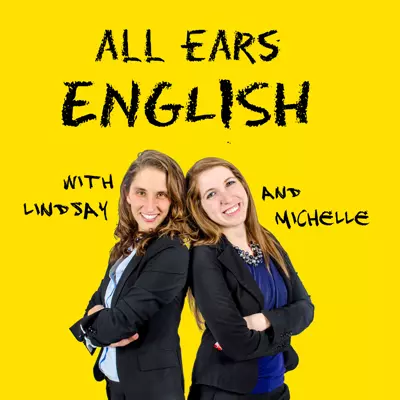
Are you looking for a new and fun way to learn American English? Come hang out with Lindsay and Michelle from Boston and New York City and have fun while you improve your English listening skills! All Ears English is an English as a Second Language (ESL) podcast for intermediate to advanced learners around the world. We will show you how to use everyday vocabulary and natural idioms, expressions, and phrasal verbs and how to make small talk in American English. We will also give you special tips on American culture, customs, etiquette, and how to speak with Americans as well as conversation and commentary on study tips, life in America and Boston, how to apply to university in the US, dating, travel, food and more. You'll get TOEFL, IELTS, and TOEIC help also from our IELTS and test expert Jessica Beck. This podcast is for adult students who are professionals and university students as well as ESL teachers. Join our community to learn to speak American English like a native! Connection NOT Perfection!
Similar Podcasts

Radio Ambulante
Radio Ambulante es un podcast pionero en español que cuenta crónicas latinoamericanas en audio, celebrando la diversidad y complejidad de la región. / Radio Ambulante is an award-winning Spanish language podcast that uses long-form audio journalism to tell neglected and under-reported Latin American and Latino stories.
Easy Russian: Learn Russian with native speakers | Учим русский с носителями языка
Maybe you’re already learning Russian with us on YouTube? On this podcast, we talk about the Russian language and the culture of the Russian-speaking countries from the perspective of our two hosts who left Russia in 2022. We also explain words and expressions and answer your questions. Members also get interactive transcripts, early access and bonus content for each episode. Learn more at www.easyrussian.fm.
Chillchat (Learn Chinese and Chill)
Are you struggling to find good listening material for learning Chinese? Are you tired of robotic and boring textbook audio? Chillchat is the answer for you! Our podcasts not only cover vocabulary and grammar, but we also talk about culture, trends, and other useful topics. With our fun and relaxing conversations, Chinese learning is a breeze! You can DOWNLOAD the transcript/study material at: https://www.buymeacoffee.com/chillchat or buy us a coffee and get a name shoutout in our show :)

AEE 245: 5 Weird Americanisms to Never Miss a Hollywood Line in English Again
Do you have trouble understanding American speech habits? In today’s Tear Up Your Textbook Tuesday, Lindsay and Michelle discuss 5 weird ways Americans use English, and how to understand what they’re saying! Taking IELTS? Get our free IELTS video course now
AEE IELTS 2: How to Avoid the Dangers on Speaking Part 1
What’s so difficult about the IELTS Speaking Part 1? What can you do to prepare? Today, Lindsay and Jessica discuss some tactics for avoiding the dangers and allowing yourself to stand out! Taking IELTS? Get our free IELTS video training course now Speaking Part 1 of the IELTS includes questions about yourself. You will be asked about three topics, and though it may seem like simple stuff, the danger is that you might become too relaxed and start using one-word answers. You want to do better than that. In fact, ideally your answers will be 2-4 sentences each! How can you do come up with that? Do some brainstorming. Think of the question words. Question words can help you think of better answers. Vocabulary is also important in Speaking Part 1. If you want to achieve a higher score, you will need to use a range of vocabulary, including slang and idioms. The examiner wants to hear that you know more than what’s in your textbook. A good strategy is to have a short list of slang and idioms ready to use. What are some good English slang words or idioms that might be helpful to have for Speaking Part 1 of the IELTS test? Let us know in the comments section below!
AEE 244: To "Do" or to "Don't"- That Is the Question!
Do you prioritize learning English? Are you a multi-tasker? Today, Lindsay and Michelle talk about the famous “to do” list, and whether or not it really moves you forward in your life or your career! Come back to our site for more
AEE 243: How a New York Painter Reached the Top and How You Can Too
How do you persist in learning English? Do you expect it to ever get easier? Today, learn how a New York-based painter went from poverty to riches by sticking with it, and how you can achieve success by following his example! Come back to our site for more tips
AEE 242: Why Hollywood Is Not Always Holly-GOOD for Your English
Can movies cause problems in speaking natural English? Today, find out why mimicking phrases from movies can make it difficult to have natural-sounding English conversations! Hollywood is drama. Its stories are fiction. This means that the language used by characters is often unrealistic. Because of the unnatural dialogue, you don’t want to quote from movies unless it’s understood that you are quoting. Native English speakers do it all the time by slightly changing the tone of their voice. Even then, such quotes are usually made in a context that makes it clear that the usage is a little joke. Some popular American movie quotes: “Life is like a box of chocolates. You never know what you’re gonna get.” – Forrest Gump “May the odds be ever in your favor.” – The Hunger Games “May the force be with you.” – Star Wars “Houston, we have a problem.” – Apollo 13 While it can be fun to directly quote movies, you want to try to sound more like a real English speaker, not a fictional character. Do you have any favorite movie quotes in English? Share the ones you love in the comments section below!
AEE Test Talk IELTS: How to Beat Writing Task 1 on the IELTS
Do you need a plan for Writing Task 1 on the IELTS exam? Today, Lindsay and Jessica share two clear steps for helping you beat it! Taking IELTS? Get our free IELTS video training course now The IELTS exam’s written section is divided into two tasks. Task 1 requires you to interpret a map or chart in approximately 150 words, while Task 2 is about 250 words on your own thoughts. Even though it is longer, Task 2 is often easier for test-takers. Task 1, because of the vocabulary needed, can be much more difficult. The Task 1 chart is usually some kind of line or graph that shows a change over time. To give yourself the language needed to discuss this chart, a good tactic might be to read the business section of the newspaper and pick up the vocabulary you need – words like that describe change, like increase, decrease, decline and skyrocket. In writing your answer for Task 1, keep it clear and simple. A good plan might be to discuss increases in paragraph one, and decreases in paragraph two. That way, your answer is organized. How are you preparing for the IELTS exam’s Task 1? Share your thoughts in the comments section below!
AEE 241: Could You Listen? Would You Listen? You Should Listen!
Do you have trouble using English modals? Today, Lindsay and Michelle give you three crazy role-plays to understand when to use should, could and would! Taking IELTS? Get our free IELTS video training course now Correct use of modals like should, could and would can be confusing. All three deal with time and possibility, and all three involve telling or asking someone to do something. Should describes the strong possible likelihood of something. It is also used to give advice. “I should arrive on time.” “You should apply for the job.” Could describes a possibility in the past or the future. It can also be used as a polite request. “She could have eaten dinner already.” “Could you pick me up at the airport?” Would is most commonly used to make a polite request. “Would you like to come with me?” “Would you ask him about the book?” How can you use should, could and would? Give us some examples in the comments section below!
AEE TEST TALK IELTS: How the Pros Prepare for the IELTS
Are you preparing to take the IELTS exam? Today, Lindsay and Jessica discuss what you need to know to pass with the score you want! Taking IELTS? Get our free IELTS video course now
AEE 240: The Four Mistakes You're Making with Your Emails in English
Do you have trouble writing an email in English? Do you worry about what kind of impression you’re making? Today, Lindsay and Michelle share four common email mistakes made by non-native English speakers, and how to correct them! Come back to our site for more info Taking IELTS? Get our free IELTS video training course now
AEE Test Talk TOEIC 1- How NOT to get Tricked Using Your Power of Prediction
Have you ever thought about taking the TOEIC? On today’s Test Talk, Lindsay and Jessica talk about using prediction in testing, and how it can help! Taking IELTS? Get our free IELTS video training course now When getting a bank account, cell phone, or internet connection in a foreign country, you need to be able to ask questions and know the right structures of conversation. If you don’t, you might not be told all of the information you need to know. By practicing, especially if you’re able to do so with a partner, you can learn to anticipate what might be said by the other person. Doing this is learning to predict, and see what you’re missing. It might make you a better test-taker. A practice conversation might go like this: “I need to open a bank account.” “Okay, to open an account, please complete this form.” “Where should I take the form?” “Give it to the woman in the office down the hall.” “When can I have my account? Today?” “No, it takes two weeks.” “Do you need my passport?” “Yes, and your birth certificate.” If you would like to learn about this strategy, hear advice on how to strengthen it with resources that are free online, and get a practice guide written by Jessica, purchase the full episode. Are you taking the TOEIC-1? If so, let us know in the comments section below!
AEE 239: Say NO to the Naysayer When It Comes to Your English
On today’s Deep Thoughts Thursday, Lindsay and Michelle consider a quote from Teddy Roosevelt, 26th President of the United States. When he was a child, Teddy Roosevelt was weak, sickly and asthmatic. He had poor eyesight, too. Yet he grew up to be one of America’s greatest symbols of achievement and individual strength. His attitude continues to inspire today, and is summed up in the following quote: Come back to our site to leave a comment
AEE Test Talk: Meet the Examiner of Excellence!
Are you thinking about testing in English? Today, Lindsay introduces Jessica, the Examiner of Excellence, who’s here to help you excel at your English tests! Taking IELTS? Get our free IELTS video training course now Test preparation doesn’t have to be boring. In fact, it should be interesting. When you’re studying for an English test, it isn’t the same as studying for a math test. You need to activate your emotions so you can remember more. Reading or watching movies in English can help, but you can also practice writing essays on subjects that are interesting to you, or go out and speak English with native speakers. Think of it as test preparation. As for taking the actual test, Jessica has four essential tips to give you an advantage: Be proactive. Take an active approach that involves your brain. Try to think about and predict answers. Trust yourself. Don’t start doubting yourself when answering questions. Often, your first answer is the correct one. Follow directions. Tests are written by smart people. Don’t start looking ahead and trying to race the clock. If you do, you might miss an important instruction. Don’t rush. Don’t worry about timing. Instead, focus on your English and do what the test asks you to do. Have you done any testing in English? How did it go? Tell us about it in the comments section below!
AEE 238: How to Rock Your English Learning
Are you sometimes unsure what to do next in life and with your English learning? Today Lindsay and Michelle talk about how to proceed when life feels overwhelming! Come back to our site for more tips Taking IELTS? Get our free IELTS video training course now
AEE 237: How to Boost Someone's Ego in English with One Simple Word
Do you ever need to comfort others in English? On today’s Tear Up Your Textbook Tuesday, Lindsay and Michelle teach you a simple trick for boosting egos and helping others see the brighter sad of unhappy situations! When someone you know tells you something sad, but not too serious, there’s a trick in English to help make them feel better. By putting ‘though’ at the end of a sentence, and raising the intonation, you can emphasize something positive about the situation in order to make the speaker feel better Come back to our site for more details
AEE 236: Warning! Information Is Habit Forming! How to Unplug
Do you have an information addiction? Today, Lindsay and Michelle will have a natural English conversation about how information addiction can affect your life, and what you can do to unplug! Come back to our website for more tips