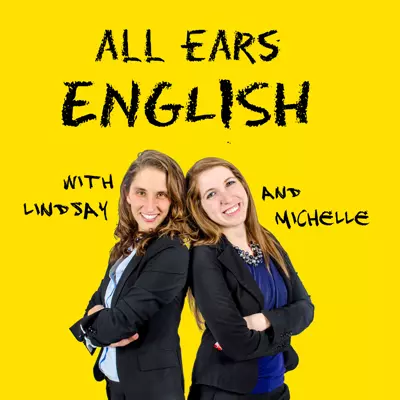
Are you looking for a new and fun way to learn American English? Come hang out with Lindsay and Michelle from Boston and New York City and have fun while you improve your English listening skills! All Ears English is an English as a Second Language (ESL) podcast for intermediate to advanced learners around the world. We will show you how to use everyday vocabulary and natural idioms, expressions, and phrasal verbs and how to make small talk in American English. We will also give you special tips on American culture, customs, etiquette, and how to speak with Americans as well as conversation and commentary on study tips, life in America and Boston, how to apply to university in the US, dating, travel, food and more. You'll get TOEFL, IELTS, and TOEIC help also from our IELTS and test expert Jessica Beck. This podcast is for adult students who are professionals and university students as well as ESL teachers. Join our community to learn to speak American English like a native! Connection NOT Perfection!
Similar Podcasts

Chillchat (Learn Chinese and Chill)
Are you struggling to find good listening material for learning Chinese? Are you tired of robotic and boring textbook audio? Chillchat is the answer for you! Our podcasts not only cover vocabulary and grammar, but we also talk about culture, trends, and other useful topics. With our fun and relaxing conversations, Chinese learning is a breeze! You can DOWNLOAD the transcript/study material at: https://www.buymeacoffee.com/chillchat or buy us a coffee and get a name shoutout in our show :)

Math Ed Podcast
Interviews with mathematics education researchers about recent studies. Hosted by Samuel Otten, University of Missouri.www.mathedpodcast.comProduced by Fibre Studios

Historias de Arte en Podcast
En Historias de Arte en Podcast, van a oír todo acerca de sus obras de arte y artistas favoritos. Para nosotras no hay nada más apasionante que investigar y enseñar lo que hay detrás del arte más famoso del mundo, cada episodio es una historia diferente, hablamos de pinturas, artistas, sus fascinantes vidas, como se hicieron famosos, o si no se hicieron famosos en vida, dónde estudiaron, las rivalidades que muchas veces surgieron y surgen entre ellos...en fin, queremos mostrar lo humano de cada obra de arte y que pasen un buen rato. Para muchos, la historia del arte es aburrida, lejana y complicada, este podcast les va a demostrar que no es así. ¡Bienvenidos! WEB: http://historiasdearte.com Síguenos en Instagram: @historiasdearte.enpodcast. Twitter: @historiasdeart1 Facebook: historias de arte en podcast
AEE 313: What Makes YOU Come Alive?
Get our FREE IELTS VIDEO TRAINING NOW What makes you come alive? To “come alive” means to become energized and excited about something. Here is the question: “Each day wake up and ask yourself, what will make you feel most alive that day.” What makes you feel happier? What makes you feel smaller or less alive? We all owe it to ourselves to think about this every day. Come back to our website for more
AEE 312: How to Set Up Your Voicemail in English in 5 Minutes or Less
Get our FREE IELTS VIDEO TRAINING NOW Are you living in the US? Have you avoided setting up your voicemail in English because you aren’t sure what to say? Today we’ll show you exactly how to set it up and what to say. If you don’t have your voicemail set up and you get a business call, most likely the person will not try to call back again so you will miss an opportunity. Come back to our website to get a summary of the steps
AEE 311: How to "Sugarcoat" Your Rejections in English
Get our FREE IELTS VIDEO TRAINING When someone has a bad idea and you don’t agree or you don’t want to accept the invitation, how can you say it in English without offending the person? Today you will find out exactly how to do it. Here are some nice ways to reject someone’s idea without being rude (how to validate someone’s idea): “That’s a great idea but what do you think about….(another suggestion)” “Hmm good thought. I think… (another suggestion)” Come back to our site to get 2 more ways to validate someone's idea in English.
AEE 310: 5 Ways to Deal with Dating Disappointment
Get our FREE IELTS VIDEO TRAINING Do you struggle when it comes to dating in English? It can be quite a challenge to try to find the “love of your life”! In today’s episode, our dating consultant, Jessica Coyle will show you how to deal with it when you become discouraged or disappointed. Come back to our site to read more
AEE 309: Are You a Planner? Find Out How to Let Serendipity Happen in Your Life
Taking the IELTS exam? Get our free IELTS video training course Do you have a 5-year plan? Do you think it’s important to have one? Today we’ll talk about why sometimes it’s good to let your plans go and relax into life a bit. Today we talked about a great quote: “It is always wise to look ahead but difficult to look further than you can see.” -Winston Churchill You can make as many plans as you want in life but you never know what’s going to happen. Here is another great quote: “Life is what happens to you when you’re busy making other plans.” -John Lennon What do you think? Should you have a 5-year plan? Do you plan for the future? Let us know your thoughts in the comments.
AEE 308: Use These English Acronyms At Your Own Risk
Get our FREE IELTS VIDEO TRAINING English acronyms are fun and easy when it comes text messaging and emailing but you need to know what impression you give the person when you use them! Today we’ll show you some common English acronyms and what impression they create. We’ll also give you some alternatives. Here are some common acronyms in English when we send text messages: LOL (“Laughing out loud”)- A lot of people get annoyed by this one. This could be used in a text message. A good alternative is “haha” TTYL (“Talk to you later”)- This one also sounds really young. A more mature alternative is “talk soon” or “talk to you soon” or actually writing out “talk to you later” SMH (“Shaking My Head”)- This is a newer acronym. You can use this when you disapprove of something that someone has done. OMG: (“Oh my gosh”)- This can also be annoying. Other options are: “Oh wow” or “I can’t believe it.” Which acronyms have you used? Let us know in the comments below.
AEE 307: Spring Has Sprung! How to Talk About it in English
Get our FREE IELTS VIDEO TRAINING Spring is finally here! It was long, cold, and tough winter and now we want to talk about spring! Do you know how to talk about spring in English? This is a great way to start English conversations these days. In today’s episode you’ll get a bunch of ways to talk about it with a native speaker. Here are some expressions from today’s episode: To spring into action: To get going, to move into action, to act quickly, to get started quickly To have a spring in your step: To have energy, to move easily and quickly, to be light on your feet Spring cleaning: To clean out your home or space after the winter, to get rid of things that you don’t need anymore To spring up: To come up, to arise spontaneously To spring ahead: To advance To spring something on someone: To surprise someone about something, to put someone under pressure with a surprise To spring for something: To buy something that is slightly out of your budget Do you love springtime? What do you like to do in the spring? Let us know in the comments!
AEE 306: What to Say in English After a Good or a Bad Date
Get our IELTS Free Video Training Do you know what to say to someone after a good or a bad date in English? Today you will find out from our favorite dating consultant, Jessica Coyle. You’ll also get some new English dating vocabulary and terms that you can use in the real world! What should we do if we have just had a good date: (1) Send a text message that evening and say: “I had a really nice time.” “Had a great time tonight. (I) Would like to see you again.” “It was really nice meeting you, let’s hit up (go to) the MOMA.” “Thanks so much for a great time.” “I enjoyed meeting you.” (2) Jessica likes to research the person online after a good first date to find out more about the person. If you had a bad date you can say: “I didn’t feel any chemistry but best of luck.” “I got more of a friend vibe.” Key vocab from today: To ghost someone: To disappear and stop communicating after you have been on a date To do the fade-away: Similar to ghosting (see above) A vibe: A general feeling or impression To go Dutch: To split the bill Jessica’s Bio: Jessica Coyle has been teaching English since 2007. She received her Master’s in TESOL in 2013, finishing with a professional project researching the use of improvisational comedy teaching techniques to teach English as a second language. She has studied and performed improv comedy all over Korea, China, Canada and the United States. She writes a dating blog called Hopeful Disasters.
AEE 305: How to Change Your Routine to Get What You Want in English and in Your Life
Come back to http://www.allearsenglish.com/305 and tell us what change you are going to make after today's episode Get our FREE IELTS CHEAT SHEET: http://www.allearsenglish.com/evaluation Today you’ll find out why staying in the same place will never get you to where you want to go and how to make an effective change quickly and easily. Here it today’s quote: “To get something you never had you have to do something you never did.” -Unknown “If you do what you’ve always done, you’ll get what you’ve always gotten.” -Tony Robbins It’s so easy to get into a habit but we have to step back and ask ourselves if our habits are creating the results that we want. Time goes by fast. We often realize that we have been doing the same thing for years and we haven’t achieved our goals. Here are some examples of our goals: Michelle’s new goal: She wants to build upper body strength. How is she working towards the goal? She is using resistance bands at her home a few times every week. Lindsay’s new goal: She wants to deepen her meditation practice. She has started going to her meditation center every morning. What about you? What are you going to change after listening to today’s episode? What change do you want to create in your life? Tell us in the comments below
AEE 304: How to Know If You Have Chemistry with Someone
Come back and tell us what your dating deal breakers are! http://www.allearsenglish.com/303 Get our FREE IELTS CHEAT SHEET: http://www.allearsenglish.com/evaluation Today we have our dating consultant, Jessica Coyle, back on the show! Today Jessica is back to talk about the concept of chemistry in dating in urban US culture. Jessica is going to tell us how to know if we actually have chemistry with someone. Chemistry: A magnetic pull between two people where you seem to understand the other person and something is different about that person to you. Two different types of chemistry: Slow burn chemistry: You start out as friends and then chemistry and attraction gradually builds over time. Features of the other person that seemed strange or unattractive initially start to become endearing and attractive. Quick chemistry/limerance: This is more of an infatuation. Jessica thinks that online dating and set ups reward this type of attraction. These connections can be really intense at first and then can fizzle out and not end well. At the same time, sometimes these attractions can work in the long run. What about in your culture? What are your deal breakers when it comes to dating? In your culture, how much influence do your parents and family have when it comes to your choice of a partner? Here are some dating vocabulary words that we talked about today: Limerance Lukewarm feelings Slow burn chemistry Quirks (personality and physical) Deal breakers Red Flag Jessica Coyle has been teaching English since 2007. She received her Master’s in TESOL in 2013, finishing with a professional project researching the use of improvisational comedy teaching techniques to teach English as a second language. She has studied and performed improv comedy all over Korea, China, Canada and the United States. How to find Jessica Online: Her dating blog: https://hopefuldisasters.wordpress.com/ Let us know your thoughts on this topic. What are your deal breakers? How important is chemistry when it comes to dating in your home culture?
AEE 303: How to Talk About What You Like Versus What You Would Like in English
Get our FREE IELTS CHEAT SHEET: http://www.allearsenglish.com/evaluation Come back to this episode and write a sample sentence- we'll tell you if you're correct: http:/www.allearsenglish.com/303 Are you STILL making this English mistake? We hear a lot of intermediate learners still getting confused between “I would like” and “I like” in English. Today you’ll get two examples of how to solve this mistake. 1) “Do you like coffee?” This means do you enjoy coffee? 2) “Would you like a coffee?” This means that someone is inviting you to have a coffee or is offering you a coffee. Listen to the role plays in the episode to hear how Lindsay and Michelle use “Do you like” versus “Would you like.”
AEE 302: Why Just Speaking May NOT Be the Best Route to Fluency in English
Come back and let us know your thoughts on this: http://www.allearsenglish.com/302 Get our FREE IELTS Cheat Sheet: http://www.allearsenglish.com/evaluation Today we have a special guest on the show! Our guest will challenge your assumption that SPEAKING is the most important part of learning English. Julian sees learning languages as a simple, two-step process: Step 1: Learn the language that we need for our specific situation Step 1: Apply the language and use it Julian’s 3 Tips- How to Keep it Practical: Try to do many different kinds of things in the language: English is a process. Spend time with it. You can’t HAVE it. You can’t GET it. You need to constantly maintain it. Julian says that there is no difference between “experiencing” the language and “learning” the language, as far as your brain is concerned. By experiencing the language in many different ways, we can acquire chunks of English which will help us to sound more native-like. You should try to encounter the language through reading, speaking, listening, writing, etc. Get a more well-rounded experience of the language instead of just focusing on speaking. Try to get a balance between intensive activity and relaxed exposure: Some of your work should be deliberate, focused, practical, intensive study. At the same time, some of your work should be a more relaxed encounter with the language. You need to take it in in a way that is enjoyable and easy. You could try listening to music in the language or watching TV. The key is getting a balance between the two forms of learning. Focus on things which are useful to YOU: Exclude things that aren’t useful to you. Don’t bother to learn things that you won’t need to use. According to Julian, we don’t become fluent in English. We become fluent in specific topics such as cooking, law, politics, art, etc. Choose your focus and pursue English in that area. Drop the idea of becoming “fluent” in English in general. Julian’s Bio: Our guest today is an English teacher from England, living in Japan. He is the father of three bilingual children, is halfway through a PhD program in Psycholinguistics and used his insight about language learning to go from speaking poor Japanese in 2008 to being a translator in 2010. Our guest today is Julian from DoingEnglish.com What do you think? Have you focused down on one specific area of English learning? What area are you focusing on? Let us know in the comments!
AEE 301: Why Forgiving Puts You On Top
Get our IELTS CHEAT SHEET HERE: http://www.allearsenglish.com/evaluation Most people think that forgiveness is weakness but today we’ll challenge your perspective with an awesome quote! Do you have any enemies? Do you have any “frenemies”? Here is today’s quote for a Deep Thoughts Thursday: “Always forgive your enemies. Nothing annoys them so much.” – Oscar Wilde What does this quote mean? This quote is somewhat “cheeky” and it says that if we want to annoy our enemies even more, we can forgive them. Also, the quote is telling us that it’s better for us to forgive. It helps us lead healthier lives. When you have an enemy you carry a lot of negative energy around and it takes up space in your body and in your brain. According to Mayoclinic.org, the benefits of forgiveness include: Stronger immune system Less anxiety Lower blood pressure A few great vocabulary words from today’s episode: Frenemy: “Friend” + “enemy”= someone that you care about and you are there for them but you can’t get along with them on an everyday basis and many things about that person bother you. To hold a grudge: You keep thinking about something that someone did to you, you hold on to your anger. You don’t move on. Do you have someone to forgive? What is holding you back from forgiving that person? Share your experience in the comments.
AEE 300: Behind the Scenes of All Ears English
Get our FREE IELTS CHEAT SHEET: http://www.allearsenglish.com/evaluation Come back to allearsenglish.com/300 and let us know what you are working on. This is our 300th episode! We are happy to be able to continue All Ears English for our amazing listeners! Today let’s talk about how All Ears English got started, what we do to publish each episode, and what it means for you if you want to put your creative vision out into the world! Today we’ll talk about: The idea: Lindsay was feeling frustrated with what she had seen in the ESL field. English learning didn’t seem to be working for many students. She was also listening to podcasts at the time and she felt an intuitive voice saying that maybe it was time to start a podcast so she found a partner to work with and got started. If you aren’t hearing any voices in your heart of mind about your creative project, look at what’s needed in the world and go out and investigate that idea. The background research: We tried our best to avoid “analysis paralysis.” We did a little bit of research to see that other people were doing this and that people were downloading these types of podcasts. When you get started on your creative vision, don’t let “research” hold you back because it may be a form of procrastination. Research is a way of staying safe and not taking the risk of launching. Production/recording: We kept in mind Seth Godin’s philosophy of “the dip.” We hit a dip in our first three months of producing this project. All Ears English almost failed. We couldn’t get the audio right. There was a learning curve, especially with the technology. We had to throw out an entire day of work because it wasn’t good enough. If you are creating something, you are going to hit a dip. You need to keep pushing beyond the dip because in the long run you will be happy that you did. Editing: Quality is king. This may sound contradictory to “Connection NOT Perfection” but it’s not because we consider our work to be art. We don’t seek perfection but we do seek the highest possible quality that we can reach. Remember, people want to see that you are human. You make mistakes and it’s fine but quality also matters. Find a balance. When you put out your vision keep this in mind. Publishing: This is the crucial moment. You have finished your project and now it’s time to show your “art” to the world. In this moment a lot of people don’t publish or they don’t “ship” because they get scared. Why is it scary? It’s scary because you are vulnerable at this time and anyone can come and criticize what you have done. Reid Hoffman says, “If you aren’t embarrassed by the first version of your product then you have launched too late.” Rinse and repeat: Four times per week we publish episodes. You need to put your work out into the world on a regular basis, not just once. This builds up a sense of resilience and self confidence. No matter what you’re working on, there is always going to be someone who doesn’t like your work but that doesn’t matter. ** Get a chance to meet with Lindsay on Skype for 15 minutes! If we get 300 comments we will choose one person to meet with Lindsay on Skype and practice English. What are YOU working on? What is your creative art or vision that you are putting out into the world? Answer these questions: 1) What are you working on? 2) What challenges have you had? 3) What have you learned?
AEE 299: 4 Topics that You Should NEVER Discuss in a First English Conversation
Come back to our blog and leave a comment. Did you bring up one of these topics on a first date? What happened? Tell us your story: http://www.allearsenglish.com/299 Get our free IELTS Chat Sheet at http://www.allearsenglish.com/evaluation Jessica is the author of Hopeful Disasters where she explores dating in New York City. She is also an ESL teacher in New York City. Check out her blog here! When you meet someone for the first time in English, whether it’s a date or just a first-time meeting with a friend or colleague, there are certain topics that you should NEVER discuss. Today you’ll find out what they are with our favorite AEE dating consultant, Jessica Coyle. A few weeks ago we talked about what four things you SHOULD talk about on a first date in English or at a first meeting but today we’ll show you what you should avoid. 4 Topics to AVOID on a first date or first meeting in English: Politics: You can casually mention your political interests but don’t get drawn into a political debate or discussion. Jessica calls this “quicksand” because you can start to sink and you’ll get stuck and you won’t be able to get out of it. It’s better to bring up this topic once you already know someone well and after you know their triggers well. Age: You should definitely avoid asking the person their exact age. Also, this means that you should not ask people about their timeline in terms of when they want to get married or have kids. It’s too direct and too intense for a first date or first conversation. You might terrify the person if start asking these questions too early. Religion: You probably have a rough idea of your date’s religion and it will be important later but it’s too personal to get into during a first date. It’s ok to share your own religion if you want to but don’t ask the person directly what their religion is. Education: This is tricky. Jessica says that the goal in not asking this question is to avoid coming off as arrogant or judgmental. If you ask the person where they went to school or how many degrees they have, it will be clear that you are fishing for information regarding their intelligence or social status. You might make the other person feel bad if you ask this question. Try to figure out if there is an intellectual connection instead.